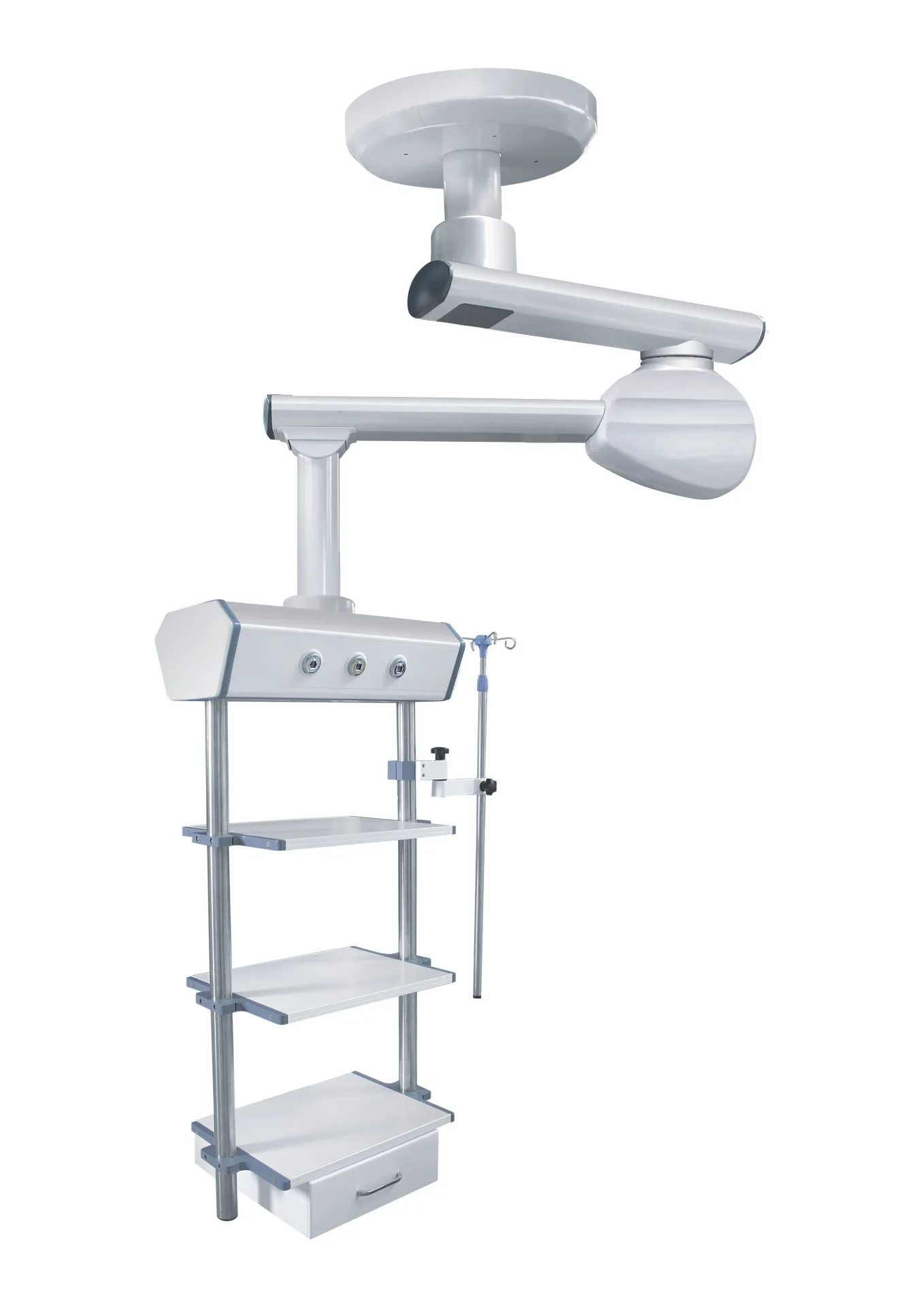
TS-DQ-100 Double-Arm Electric Endoscopy Pendant — Dual-Arm Motorized Lift Platform for Advanced Minimally Invasive and Hybrid Surgery
Product Title
TS-DQ-100 Double-Arm Electric Endoscopy Pendant | Dual-Arm Motorized Height Adjustment | Imaging Stack and Surgical Instrument/Energy Device Separation | 350 kg Bearing Capacity | 0–350° Arm and Trunk Rotation | Electro-Magnetic Brake System | 550–600 mm Electric Lifting Range | Five Combinable Arm Length Options
Product Overview
The TS-DQ-100 Double-Arm Electric Endoscopy Pendant is a purpose-engineered dual-arm, motorized-lift ceiling pendant designed specifically for the unique equipment density and workflow demands of advanced minimally invasive surgery, bariatric surgery, thoracoscopy, and interventional endoscopy — procedures where the operating room ceiling must support a dense array of imaging equipment, surgical instruments, energy devices, and insufflation systems while maintaining clear separation between the imaging stack and the surgical instrument field to prevent cable entanglement, equipment interference, and workflow disruption.
At the core of this pendant's design philosophy is the functional separation of the imaging stack from the surgical instrument and energy device zone — a critical architectural decision that reflects the real-world workflow of modern endoscopic and minimally invasive surgery. In advanced laparoscopic, thoracoscopic, and bariatric procedures, the surgical team must manage a complex array of imaging equipment — including the endoscopic camera head, light source, video processor, insufflator, and printer/recorder — on one side, while simultaneously organizing the surgical instruments, energy devices (electrosurgical generators, ultrasonic dissectors, vessel sealing devices), suction/irrigation systems, and specimen retrieval equipment on the other. By dedicating one arm to the imaging stack and the second arm to surgical instruments and energy devices, the TS-DQ-100 eliminates the cable congestion, tubing entanglement, and equipment interference that plague single-arm pendants in advanced minimally invasive procedures — giving the surgical team two distinct, uncluttered, and independently adjustable work zones that mirror the natural workflow of the endoscopic operating room.
Both arms are capable of independent motorized height adjustment through an electric lifting mechanism that provides a 550–600 mm vertical travel range, enabling each arm to be positioned at the exact working height required for its specific equipment load — the imaging arm at the optimal height for monitor visibility and camera cable management, and the surgical instrument arm at the precise height needed for ergonomic instrument access and energy device cable routing. The motorized lift eliminates the physical effort required to reposition heavy equipment-laden arms manually, and the electric drive ensures smooth, precise, and reproducible height changes that can be performed by a single operator without disrupting the sterile field or the equipment mounted on the arm.
The pendant's structural system delivers a 350 kg bearing capacity — ensuring that the arms can support the combined weight of the imaging stack (camera head, light source, video processor, insufflator, and monitors), surgical instruments, energy devices, suction/irrigation systems, and accessory equipment without deflection, sag, or drift. Both the arm body and the trunk (box) body feature 0–350° rotation, providing near-complete circumferential coverage of the endoscopic workstation area while the electro-magnetic brake system (with pneumatic brake and damping brake options available) locks each arm securely at any position within its range of motion, preventing unintended drift or movement under the sustained load of heavy imaging and surgical equipment.
With combinable arm body lengths of 600+800 mm, 600+1000 mm, 600+1200 mm, 800+1000 mm, and 800+1200 mm — yielding effective working radii from 980 mm to 1660 mm — the TS-DQ-100 can be configured to match the exact spatial requirements of any operating room layout, from compact endoscopy procedure rooms to large hybrid operating theaters where the endoscopic workstation must span a wide arc around the surgical table while coexisting with C-arm imaging systems, robotic arms, and advanced navigation equipment.
Key Features & Clinical Advantages
Dual-arm functional separation — imaging stack and surgical instrument/energy device zones — The imaging stack (camera head, light source, video processor, insufflator, monitors) and the surgical instruments and energy devices (electrosurgical generators, ultrasonic dissectors, vessel sealers, suction/irrigation) are carried on independent arms, eliminating the cable congestion, tubing entanglement, and equipment interference that compromise endoscopic surgical workflow. Each arm can be positioned, rotated, and height-adjusted independently, creating two distinct, uncluttered work zones that mirror the natural workflow of the advanced endoscopic operating room.
Independent motorized height adjustment on both arms — Each arm features its own electric lifting mechanism providing 550–600 mm of vertical travel, enabling precise, effort-free height positioning of each arm to match the ergonomic requirements of its specific equipment load — the imaging arm at the optimal height for monitor visibility and camera cable management, and the surgical instrument arm at the precise height needed for ergonomic instrument access and energy device cable routing.
350 kg bearing capacity — The structural system supports the combined weight of the imaging stack, surgical instruments, energy devices, suction/irrigation systems, and accessory equipment without deflection, sag, or drift — ensuring stable, reliable performance throughout lengthy bariatric, thoracoscopic, and complex laparoscopic procedures where equipment loads are at their maximum.
0–350° arm body and trunk (box) body rotation — Near-complete circumferential rotation on both the arm body and the trunk body enables the pendant to reach any position within its working radius, accommodating operating room layouts where the endoscopic workstation must be positioned at unconventional angles relative to the surgical table — particularly important in hybrid procedures where the pendant must coexist with C-arm imaging systems and robotic surgical arms.
Electro-magnetic brake system with optional pneumatic and damping brakes — The standard electro-magnetic brake provides reliable, maintenance-free locking of each arm at any position within its range of motion. Optional pneumatic brake and damping brake configurations are available for facilities that prefer the smooth, progressive braking characteristics of pneumatic systems or the vibration-dampening performance of damping brakes — particularly valuable in endoscopic surgery where vibration transmitted through the pendant structure can degrade the quality of the endoscopic image displayed on the monitors.
Combinable arm body lengths for customized working radius — Five arm length combinations — 600+800 mm, 600+1000 mm, 600+1200 mm, 800+1000 mm, and 800+1200 mm — yield effective working radii from 980 mm to 1660 mm, enabling the pendant to be configured to match the exact spatial requirements of any operating room layout, from compact endoscopy suites to large hybrid operating theaters.
Streamlined operating room integration — The double-arm electric design combines ceiling supply, motorized height adjustment, and dual-zone equipment mounting in a single integrated system, eliminating the need for multiple freestanding equipment carts, floor-mounted stands, and ad hoc cable management solutions that clutter the operating room floor, create trip hazards, and impede staff movement during complex endoscopic procedures.
Reduced floor clutter and improved sterile field management — By moving the imaging stack, surgical instruments, and energy devices from the floor to the ceiling, the TS-DQ-100 frees valuable floor space around the surgical table, reduces the number of cables and tubing crossing the floor, and improves the surgical team's ability to maintain a clean, organized sterile field — particularly important in bariatric surgery where the large patient body habitus already constrains the available working space around the table.
Technical Specifications
Arm Body Length Combinations
The TS-DQ-100 offers five combinable arm body length configurations, each designed to deliver a specific effective working radius that matches the spatial requirements of different operating room layouts and procedural complexity levels:
600 + 800 mm — This compact configuration delivers an effective working radius of 980 mm, making it the preferred choice for operating rooms with limited ceiling space or where the endoscopic workstation must operate within a confined arc — such as compact endoscopy procedure rooms, outpatient surgery centers, and interventional endoscopy suites where ceiling-mounted equipment density is high and every millimeter of working radius must be optimized to avoid spatial conflicts with overhead surgical lights and other ceiling-mounted systems.
600 + 1000 mm — Providing an effective working radius of 1100 mm, this mid-range configuration balances reach and structural rigidity for standard operating rooms performing advanced laparoscopic surgery, bariatric surgery, and thoracoscopic procedures where the endoscopic workstation must extend beyond the immediate surgical field without encroaching on the overhead surgical lights or other ceiling-mounted infrastructure.
600 + 1200 mm — With an effective working radius of 1380 mm, this extended configuration is designed for large operating rooms where the endoscopic workstation must span a wide arc around the surgical table — such as hybrid operating rooms with advanced imaging systems, bariatric surgery suites where the anesthesia workstation and surgical instrument carts must be positioned at a distance from the surgical field due to the large patient body habitus, and thoracic surgery operating rooms where the endoscopic workstation must reach around the surgical table to maintain access to the patient's lateral ports.
800 + 1000 mm — Delivering an effective working radius of 1460 mm, this configuration uses a longer first arm segment to provide enhanced reach while maintaining the structural rigidity needed to support heavy equipment loads at extended reach. It is particularly suited for large bariatric operating rooms where the imaging stack and surgical instrument arms must be positioned well lateral to the surgical table to avoid interference with the surgical team while maintaining full equipment accessibility across the wide operative field.
800 + 1200 mm — The maximum-reach configuration with an effective working radius of 1660 mm, designed for the largest operating rooms and the most complex procedural environments — including hybrid operating rooms where the pendant must coexist with C-arm imaging systems, robotic surgical arms, and advanced navigation equipment simultaneously without spatial conflict, and thoracic surgery suites where the endoscopic workstation must span the widest possible arc to maintain access to both the anterior and posterior port sites during video-assisted thoracoscopic surgery (VATS).
Rotation and Braking
Both the arm body and the trunk (box) body rotate through a full 0–350° range, providing near-complete circumferential coverage. The 350° rotation — rather than a full 360° — is a deliberate design choice that prevents cable and tubing wrap-around during continuous rotation, ensuring that endoscopic camera cables, light guide cables, insufflation tubing, electrosurgical pencil cables, ultrasonic device cables, and suction/irrigation tubing remain untangled regardless of the arm's rotational position.
The standard electro-magnetic brake system provides reliable, maintenance-free locking of each arm at any position within its range of motion. When the operator releases the positioning control, the electro-magnetic brake engages instantly, holding the arm firmly in place under the full 350 kg load without drift, creep, or gradual settling. Two optional braking configurations are available for facilities with specific requirements: the pneumatic brake provides smooth, progressive braking that is preferred in environments where the operator values the tactile feedback of pneumatic resistance during arm positioning; and the damping brake provides vibration-dampening performance that is particularly valuable in endoscopic surgery where mechanical vibration transmitted through the pendant structure can degrade the quality of the endoscopic image displayed on the monitors — a phenomenon that becomes increasingly noticeable at higher magnification levels during advanced laparoscopic and thoracoscopic procedures.
Motorized Lifting System
The electric lifting mechanism provides a vertical travel range of 550–600 mm, enabling each arm to be positioned at the exact working height required for its specific equipment load. The motorized drive ensures smooth, precise, and reproducible height changes that can be performed by a single operator without physical effort — a significant ergonomic advantage over manual gas-spring lift systems that require the operator to support the weight of the arm and its equipment load during height adjustment. The electric lift also provides consistent lifting force throughout the entire travel range, unlike gas-spring systems whose lifting force varies with temperature and degrades over time as the gas spring ages.
In the endoscopic surgery context, the motorized lift is particularly valuable for adjusting the imaging arm height to match the surgeon's line of sight — ensuring that the endoscopic monitor is positioned at the optimal eye-level height to reduce neck strain during lengthy laparoscopic and thoracoscopic procedures — while independently adjusting the surgical instrument arm height to match the ergonomic requirements of instrument access and energy device cable management at the surgical field.
Clinical Applications
The TS-DQ-100 Double-Arm Electric Endoscopy Pendant is engineered for the most demanding minimally invasive and hybrid surgical environments:
Advanced laparoscopic surgery — Complex laparoscopic procedures including laparoscopic colectomy, laparoscopic gastrectomy, laparoscopic hepatectomy, and laparoscopic pancreaticoduodenectomy require the surgical team to manage a dense array of imaging equipment (camera head, light source, video processor, insufflator) on one arm and surgical instruments and energy devices (electrosurgical generators, ultrasonic dissectors, vessel sealers, staplers, suction/irrigation systems) on the other — with both arms independently height-adjustable to match the ergonomic requirements of the imaging display and the surgical field.
Bariatric surgery — Laparoscopic sleeve gastrectomy, laparoscopic Roux-en-Y gastric bypass, and revisional bariatric procedures require extensive imaging and instrument support in an operating room where the large patient body habitus constrains the available working space around the table. The dual-arm separation keeps the imaging stack cables from interfering with the surgical instrument cables, and the extended working radius configurations (up to 1660 mm) enable the pendant arms to reach around the bariatric patient's body to maintain access to all port sites.
Thoracoscopy and VATS — Video-assisted thoracoscopic surgery including lobectomy, segmentectomy, pleural procedures, and mediastinal mass resection requires the endoscopic workstation to be positioned to avoid interference with the surgical team's access to the patient's lateral and posterior thoracic ports. The 0–350° rotation and motorized height adjustment enable the pendant arms to be positioned precisely where they are needed without encroaching on the surgical field, and the damping brake option minimizes vibration transmission that could degrade the thoracoscopic image quality.
Interventional endoscopy — Advanced therapeutic endoscopy procedures including endoscopic mucosal resection (EMR), endoscopic submucosal dissection (ESD), endoscopic retrograde cholangiopancreatography (ERCP), and endoscopic ultrasound (EUS) with fine-needle aspiration require the endoscopy tower (processor, light source, insufflator, suction) to be positioned at the optimal height and distance from the patient for the endoscopist's ergonomic comfort, while the accessory equipment (electrosurgical generator, aspiration pump, specimen retrieval devices) is organized on a separate arm for uncluttered access.
Hybrid endoscopic procedures — Procedures combining endoscopic and fluoroscopic guidance — including laparoscopic intraoperative cholangiography, laparoscopic ultrasound-guided liver tumor ablation, and hybrid NOTES (natural orifice transluminal endoscopic surgery) procedures — require the pendant to coexist with C-arm imaging systems in a crowded ceiling infrastructure environment. The configurable arm lengths and 0–350° rotation enable the pendant to be positioned to avoid spatial conflicts with imaging equipment while maintaining full accessibility for the endoscopic and surgical teams.
Robotic-assisted laparoscopic surgery — Robotic surgical systems including the da Vinci platform require dedicated ceiling infrastructure for the robotic arms, and the endoscopy pendant must be positioned to avoid any spatial conflict with the robotic system's overhead components. The TS-DQ-100's configurable arm lengths and full rotation capability enable precise positioning of the endoscopic workstation in the available ceiling space without interfering with the robotic system, while the dual-arm separation ensures that the imaging stack and surgical instrument cables do not entangle with the robotic arm cables.
Single-incision laparoscopic surgery (SILS) — Single-incision procedures concentrate all instruments and the endoscope through a single port, creating a dense cable and tubing bundle at the port site that requires meticulous management to prevent entanglement. The dual-arm separation keeps the imaging cables on one arm and the instrument/energy device cables on the other, reducing the cable congestion at the single port site and improving the surgeon's ability to manipulate instruments without cable interference.
Pediatric minimally invasive surgery — Pediatric laparoscopic and thoracoscopic procedures require the same imaging and instrument support as adult procedures, but in a smaller physical workspace where the pendant arms must be positioned close to the patient without interfering with the surgical team's access to the small operative field. The compact arm length configurations (600+800 mm and 600+1000 mm) provide the reach needed while maintaining a manageable working radius for the constrained pediatric operating room.
Urological endoscopic surgery — Laparoscopic and robotic-assisted laparoscopic urological procedures including nephrectomy, prostatectomy, pyeloplasty, and cystectomy require extensive imaging and instrument support with the dual-arm configuration keeping the endoscopic imaging stack separate from the surgical instruments and energy devices used for dissection, hemostasis, and specimen morcellation.
Gynecological laparoscopic surgery — Complex gynecological laparoscopic procedures including laparoscopic hysterectomy, myomectomy, endometriosis excision, and pelvic lymph node dissection require the endoscopic workstation to support the imaging stack and the surgical instruments and energy devices on separate arms, with the motorized height adjustment enabling the imaging arm to be positioned at the optimal height for the surgeon's line of sight during deep pelvic dissection.
Emergency laparoscopic surgery — Emergency laparoscopic procedures including laparoscopic appendectomy for perforated appendicitis, laparoscopic cholecystectomy for acute cholecystitis, and diagnostic laparoscopy for acute abdominal pain benefit from the pendant's rapid, motorized height adjustment that enables the surgical team to set up the endoscopic workstation quickly and adjust the arm positions as the procedure evolves from diagnostic to therapeutic.
Training and education — The dual-arm configuration with independent height adjustment enables the attending surgeon and the trainee to each have their own optimized equipment zone, with the imaging arm positioned for the primary surgeon's line of sight and the instrument arm positioned for the trainee's ergonomic access — facilitating supervised training in advanced laparoscopic techniques without equipment conflicts.
SEO Search Terms & Tags
double-arm electric endoscopy pendant · dual-arm endoscopy pendant · TS-DQ-100 endoscopy pendant · motorized endoscopy pendant · electric lift endoscopy pendant · endoscopy boom dual arm · advanced laparoscopic surgery pendant · bariatric surgery endoscopy pendant · thoracoscopy pendant · VATS endoscopy pendant · interventional endoscopy pendant · imaging stack surgical instrument separation · 350 kg bearing capacity endoscopy pendant · electro-magnetic brake endoscopy pendant · pneumatic brake endoscopy pendant · damping brake endoscopy pendant · 0-350 degree rotation endoscopy pendant · 550-600 mm electric lifting endoscopy pendant · combinable arm length endoscopy pendant · 980 mm working radius endoscopy pendant · 1660 mm working radius endoscopy pendant · hybrid OR endoscopy pendant · robotic surgery endoscopy pendant · single-incision laparoscopic surgery pendant · pediatric laparoscopic pendant · ceiling-mounted endoscopy pendant · operating room endoscopy boom · OR ceiling equipment pendant · endoscopic workstation pendant · camera head mounting pendant · light source mounting pendant · video processor mounting pendant · insufflator mounting pendant · energy device mounting pendant · electrosurgical generator mounting pendant · ultrasonic dissector mounting pendant · vessel sealer mounting pendant · suction irrigation mounting pendant · laparoscopic equipment management · operating room ceiling infrastructure · OR equipment support system · endoscopy tower ceiling mount · minimally invasive surgery pendant · laparoscopic equipment organization · cable management endoscopy pendant · dual-zone equipment mounting
Meta Description (for product listing pages)
← Back to all productsTS-DQ-100 Double-Arm Electric Endoscopy Pendant — dual-arm motorized lift endoscopy platform with imaging stack and surgical instrument/energy device functional separation. Independent electric height adjustment on both arms (550–600 mm travel). 350 kg bearing capacity. 0–350° arm and trunk rotation. Electro-magnetic brake system with pneumatic and damping brake options. Five combinable arm lengths (600+800 mm to 800+1200 mm) with effective working radii from 980 mm to 1660 mm. Ideal for advanced laparoscopic surgery, bariatric surgery, thoracoscopy, VATS, interventional endoscopy, robotic-assisted procedures, and all advanced minimally invasive surgical procedures requiring dual-zone equipment mounting and motorized height adjustment.