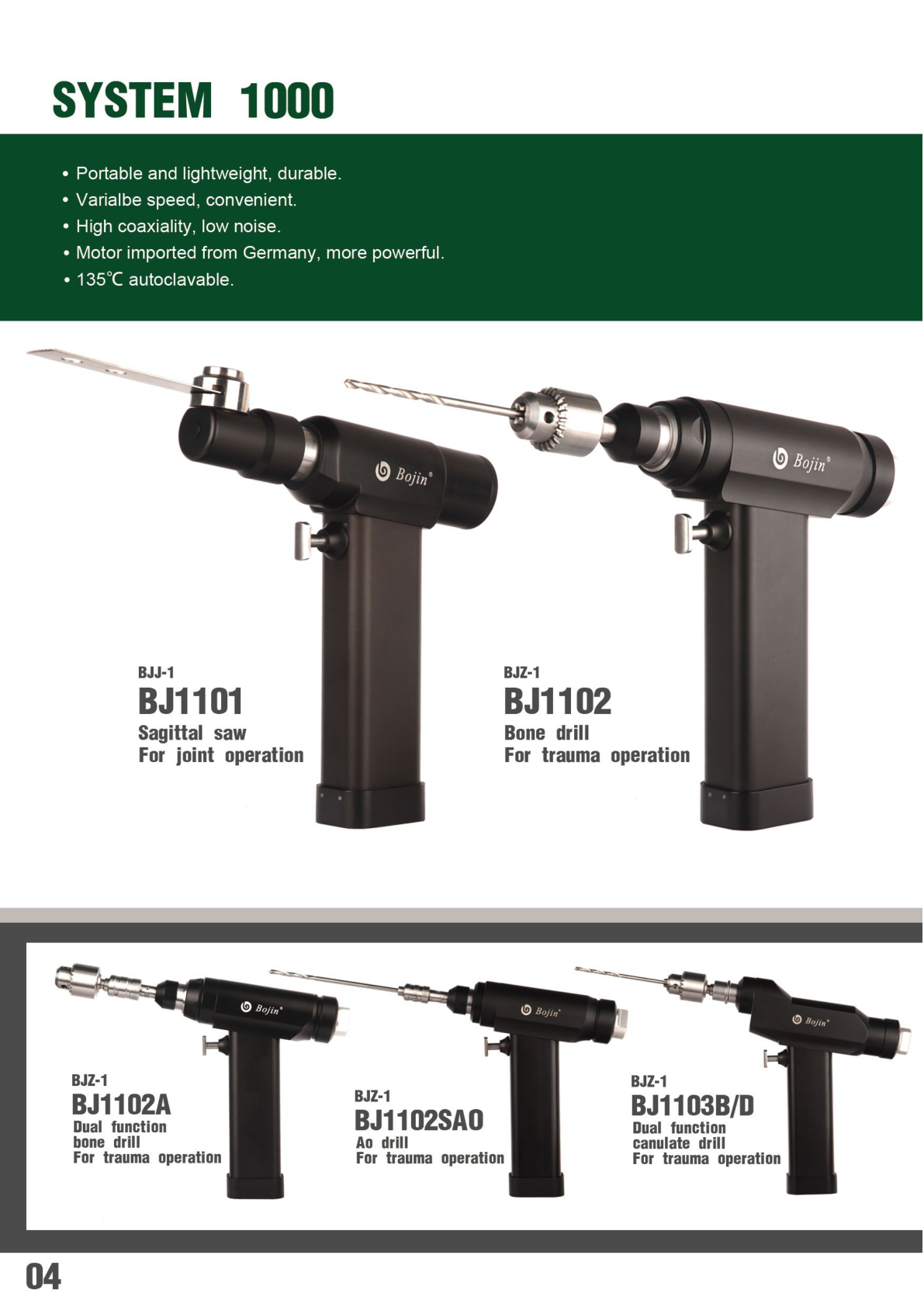
System 1000 Surgical Power Tool Series — Cordless Orthopedic Drill & Saw Lineup
The Bojin System 1000 is a comprehensive battery-driven orthopedic power tool family engineered for joint replacement, trauma fixation, cranial neurosurgery, and thoracic surgery. The series pairs a Germany-imported high-performance motor with a lightweight, ergonomic handpiece to deliver reliable torque, low noise, and 135°C autoclavable sterility for every operating room. Twelve specialized handpieces share the same Ni-MH/Li-ion battery platform, single charger, and aseptic transfer kit — allowing surgical teams to standardize on one trusted System across orthopedic, neurosurgical, and emergency procedures.
Key Advantages of the System 1000 Series
- Germany-imported motor delivers strong, stable torque output for cortical and cancellous bone.
- Variable speed trigger with high coaxiality reduces hand fatigue and improves cutting precision.
- 135°C autoclavable handpieces withstand repeated steam sterilization cycles.
- Modular battery, charger, lid, and aseptic transfer kit minimize operating-room turnover time.
- Lightweight, balanced housing supports prolonged joint replacement and trauma procedures.
- Low-noise operation creates a calmer environment for surgical teams and patients.
Models in the System 1000 Series — Specific Advantages and Differences
BJ1101 Sagittal Saw — For Joint OperationAdvantage: Oscillating sagittal blade cuts bone with high accuracy in total knee and hip arthroplasty.
Difference vs BJ1109: Sagittal (side-to-side) stroke vs BJ1109's reciprocating (back-and-forth) stroke — BJ1101 is preferred for precise bone sculpting around the joint capsule.
Advantage: Single-function high-speed drill for standard K-wire and screw hole preparation in orthopedic trauma plating.
Difference vs BJ1102A / BJ1102SA0: Single cannulation mode vs dual-function (BJ1102A adds pin driving) or AO quick-coupling chuck (BJ1102SA0).
Advantage: Switches between cannulated drilling and pin driving without changing handpiece, saving OR setup time.
Difference vs BJ1102: Adds a pin-driving mode for intramedullary fixation when a single handpiece must cover both drilling and K-wire insertion.
Advantage: Compatible with the global AO/ASIF quick-coupling standard for trauma drill bits and screwdriver shafts.
Difference vs BJ1102A: Uses an AO-type Jacobs chuck instead of a keyless cannulated chuck — ideal for AO locking plate systems.
Advantage: Cannulated chuck accepts guide-wire-driven drilling for minimally invasive fracture fixation.
Difference vs BJ1103B / BJ1103D: Single-function design; BJ1103B / BJ1103D add dual forward/reverse or oscillating modes for reaming and tapping.
Advantage: Dual forward/reverse (D) or oscillating (B) mode enables reaming and tapping in a single instrument for difficult fracture patterns and intramedullary reaming.
Difference vs BJ1103: Adds multi-mode rotation for advanced trauma cases.
Advantage: Low-speed, high-torque drilling designed for burr-hole and craniotomy procedures with reduced heat generation.
Difference vs BJ1105: Twist-drill bit (axial) vs bur (side-cutting) attachment — BJ1104 for skull perforation, BJ1105 for shaping.
Advantage: High-speed diamond and carbide burs for cranioplasty, skull base, and tumor resection work.
Difference vs BJ1104: Bur vs drill action — BJ1105 for cortical bone contouring, BJ1104 for initial perforation.
Advantage: Reciprocating sternum blade with a safety guard for median sternotomy in cardiac surgery.
Difference vs BJ1109: Sternum-specific guard and blade geometry vs the general-purpose reciprocating saw.
Advantage: Heavy-duty reaming torque for acetabular cup preparation in total hip arthroplasty; dual-mode for both clockwise reaming and counter-clockwise release.
Difference vs BJ1101: Reaming drill, not oscillating saw — pairs with the System 1400 detachable acetabulum reamer heads (BJ1107B1 / BJ1107B1T).
Advantage: Reinforced blade and longer stroke handle dense, calcified re-sternotomy bone during revision cardiac surgery.
Difference vs BJ1106: Built for second-time (redo) thoracotomy where scar tissue and ossification demand extra power and reach.
Advantage: Linear back-and-forth stroke for rapid bone resection in long-bone and joint arthroplasty.
Difference vs BJ1101: Reciprocating (linear) vs sagittal (oscillating) stroke — choose BJ1109 for long cuts and BJ1101 for precise shaping.
Standard System 1000 Accessories
- BJ1001 Rechargeable Battery — high-capacity Ni-MH/Li-ion cell for the 1000 / 2000 / 8000 platforms.
- BJ1002 Battery Charger — single-bay fast charger for the 1000 series battery.
- BJ1003 Battery Lid — sealed cover for aseptic battery transfer.
- BJ1004 Aseptic Transfer Kit — sterile barrier for handpiece-to-battery docking.
- BJ1005 Chuck Key — universal key for Jacobs chuck replacement across all Bojin drills.
- BJ1002-4 Multi-Function Charger — four-bay charger for high-volume surgical centers.
Technical Specifications
- Motor: Germany-imported DC motor, variable speed trigger
- Power source: Detachable Li-ion / Ni-MH battery (BJ1001)
- Sterilization: 135°C autoclavable handpiece
- Handpiece weight: lightweight, balanced ergonomic housing
- Compliance: CE-marked, ISO 13485 certified
Typical Applications
Trauma surgery, joint replacement (hip / knee), cranial neurosurgery, thoracic surgery (including redo sternotomy), sports medicine orthopedics, veterinary orthopedics, and emergency fracture fixation in hospitals, ambulatory surgery centers, and field hospitals.
Frequently Asked Questions
Q: Can System 1000 batteries be used in System 2000 or System 8000?
A: Yes. The BJ1001 battery, BJ1002 charger, and BJ1004 aseptic transfer kit are shared across System 1000, System 2000, and System 8000 platforms.
Q: What is the difference between BJ1103, BJ1103B, and BJ1103D?
A: BJ1103 is a single-function cannulated drill. BJ1103B adds dual forward / reverse rotation; BJ1103D adds an oscillating mode for reaming and tapping in difficult fracture patterns.
Q: Is the System 1000 handpiece autoclavable?
A: Yes, every System 1000 handpiece is rated for 135°C steam autoclave sterilization. The battery is detached before autoclaving.