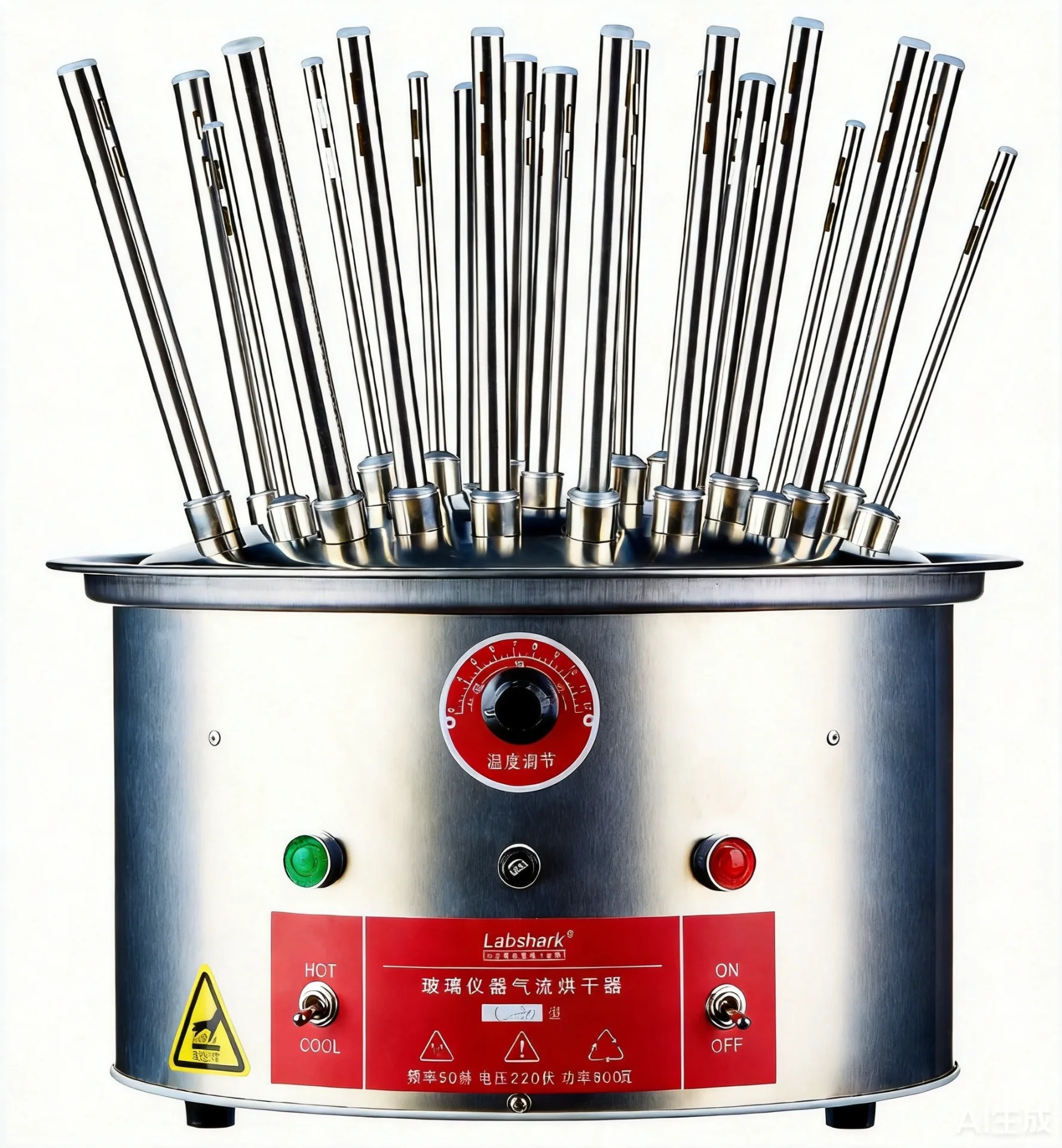
Product Overview
A glass-instrument airflow dryer, also known as a blower dryer, air dryer, or glassware dryer, is the standard drying solution for volumetric flasks, beakers, Erlenmeyer flasks, conical flasks, test tubes, graduated cylinders, and other narrow-neck glassware used in chemical, pharmaceutical, and analytical laboratories. BKMAMLAB Labshark airflow dryers use forced hot-air circulation to evaporate residual moisture inside and outside glassware in minutes, eliminating water spots, fingerprints, and breakage that often occur during manual towel or oven drying.
Key Features & Advantages
- Three configurations: Airflow Dryer C-10 (10 drying positions, 188 mm height), C-20 (20 positions, 188 mm height for high-throughput labs), and C-30 (8 positions, 162 mm height for shorter glassware).
- Forced hot-air circulation: Dries glassware inside and out in minutes, eliminating water spots and fingerprints.
- Stainless-steel body: Anti-rust surface finish for long-term durability in wet laboratory environments.
- Adjustable temperature control: Customizable drying temperature for different glassware types and thermal sensitivity.
- Mechanical timer: Enables unattended operation with automatic shut-off.
- Replaceable air nozzles: Fit different glassware diameters for versatile drying capability.
Technical Specifications
- Models: C-10 (10 positions, 188 mm), C-20 (20 positions, 188 mm), C-30 (8 positions, 162 mm)
- Body material: Stainless steel with anti-rust finish
- Temperature control: Adjustable
- Timer: Mechanical timer for unattended operation
- Air nozzles: Replaceable, fit different glassware diameters
- Operating ambient temperature: 5°C to 40°C
- Relative humidity: ≤80%
- Altitude: Up to 2000 m, indoor use
Comparison & Competitive Advantages
Unlike manual towel drying that leaves lint, fingerprints, and residual moisture, the BKMAMLAB Labshark airflow dryer delivers spotless, uniformly dried glassware using forced hot-air circulation. Compared to oven drying that is slow and requires high energy consumption, the airflow dryer dries glassware in minutes with targeted air delivery to internal and external surfaces. The C-20 model with 20 drying positions is particularly advantageous for high-throughput laboratories, doubling the capacity of standard 10-position dryers without requiring additional bench space.
Applications
Ideal for drying cleaned glassware before use, drying volumetric glassware for analytical-balance work, post-wash preparation of glassware for trace-metal analysis, pharmaceutical lab glassware drying, environmental-testing lab support, and academic-research lab support. Particularly valuable for analytical chemistry laboratories where water residue can affect gravimetric and spectroscopic measurements.
Frequently Asked Questions
Q: What is a glass-instrument airflow dryer used for?
A: A glass-instrument airflow dryer is used to rapidly dry laboratory glassware such as volumetric flasks, beakers, test tubes, and graduated cylinders using forced hot-air circulation. It eliminates water spots, fingerprints, and breakage associated with manual towel or oven drying.
Q: Which BKMAMLAB Labshark airflow dryer model should I choose?
A: The C-10 (10 positions, 188 mm height) is suitable for standard labs, the C-20 (20 positions, 188 mm height) is recommended for high-throughput laboratories, and the C-30 (8 positions, 162 mm height) is designed for shorter glassware. Choose based on your daily glassware volume and typical vessel height.
Q: How does the airflow dryer compare to oven drying?
A: The airflow dryer is significantly faster than oven drying because it directs hot air specifically into and around the glassware, targeting residual moisture directly. It also consumes less energy and prevents thermal shock that can occur when glassware is placed in a preheated oven.
Q: What safety precautions should be followed when using the airflow dryer?
A: Maintain at least 10 cm clearance on all sides during operation. Avoid conductive dust, explosive gases, and corrosive vapors. Do not use for continuous unattended heating; allow the unit to cool to room temperature before storage.
← Back to all products