Adjustable Stainless-Steel Arch Frames — Prone-Position Spinal Surgery Posture Support for Cervical, Thoracic, Lumbar & Extended Spinal Procedures
Product Title
Adjustable Stainless Steel Arch Frame and Carbon Fiber Arch Frame for Spinal Surgery | Prone Position Spine Posture Frame with 0–150 mm and 0–250 mm Adjustable Arch Spacing | High-Density Rebound Sponge with Anti-Static PU Leather | Disassemblable for Cleaning | Universal Operating Table Compatibility
Product Overview
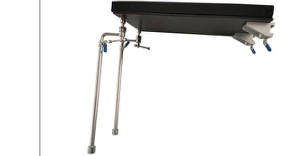
This specialized range of adjustable stainless-steel arch frames and carbon-fiber arch frames provides the essential prone-position posture support system for cervical spine, thoracic spine, lumbar spine, and full-spine surgical procedures where the patient must be positioned face-down with the abdomen hanging freely to reduce intra-abdominal pressure, minimize epidural venous engorgement, and decrease intraoperative blood loss. Each arch frame spans the patient's torso from the chest to the pelvis, creating a broad, stable support structure that bears the patient's weight on the thorax and iliac crests while leaving the entire posterior spinal column — from the occiput to the sacrum — completely exposed and accessible for surgical instrumentation.
The defining feature of this arch frame family is the adjustable arch spacing — each frame can be set to span from 0–150 mm (stainless steel models) or 0–250 mm (carbon fiber model) on both sides, allowing the surgical team to match the arch width precisely to the patient's body habitus and the specific lordotic curvature of the spinal segment being operated on. This adjustability is not merely a convenience — it is a clinical necessity. In cervical spine surgery, the arch must accommodate the relatively narrow thoracic aperture and the lordotic curve of the cervical spine; in lumbar surgery, the arch must span the wider pelvic basin and accommodate the deeper lordotic curve of the lumbar spine; and in bariatric patients, the arch must open wide enough to prevent abdominal compression in patients with significantly increased abdominal girth. The adjustable spacing mechanism allows a single arch frame to serve all of these requirements — eliminating the need to stock separate frames for each body type and spinal level.
All cushion surfaces are constructed from high-density rebound sponge encased in anti-static PU leather, providing firm, pressure-distributing support that resists compression set during prolonged procedures while enabling rapid wipe-down disinfection between cases. Every arch frame in the range disassembles completely for thorough cleaning and sterilization — including the cushion, the frame joints, and the mounting hardware — ensuring compliance with infection-control protocols in the highest-acuity spinal surgery environments.
Key Features & Clinical Advantages
Adjustable arch spacing — 0–150 mm and 0–250 mm — The stainless steel models offer adjustable arch spacing of 0–150 mm on both sides, while the carbon fiber model provides an extended range of 0–250 mm — enabling the arch to be configured to match the patient's body habitus, abdominal girth, and the specific lordotic curvature of the spinal segment being operated on. This adjustability ensures that the abdomen hangs freely without compression across the full spectrum of patient sizes — from slender adults to bariatric patients — and across all spinal levels from cervical to lumbar.
High-density rebound sponge with anti-static PU leather — All patient-contact cushion surfaces are constructed from high-density rebound sponge that maintains its shape and support properties throughout prolonged procedures without bottoming out under the patient's weight. The anti-static PU leather cover prevents electrostatic charge buildup — a critical safety feature in spinal surgery where static discharge could interfere with intraoperative neurophysiological monitoring (IONM) equipment, including somatosensory evoked potentials (SSEPs) and motor evoked potentials (MEPs) that are routinely used to monitor spinal cord function during decompression and instrumentation.
Disassemblable for thorough cleaning — Every arch frame disassembles completely without tools, enabling thorough cleaning and sterilization of all components — including the cushion, the frame joints, the adjustment mechanisms, and the mounting hardware — between each case. This is essential for maintaining infection-control compliance in spinal surgery, where post-operative surgical site infection carries devastating consequences including meningitis, epidural abscess, and implant-related infection.
Stainless steel and carbon fiber construction options — The stainless steel models provide maximum structural rigidity and durability for routine spinal procedures, while the carbon fiber model offers reduced weight and full radiolucency for C-arm guided procedures where intraoperative fluoroscopy is used to verify implant position, screw trajectory, and decompression adequacy in real time.
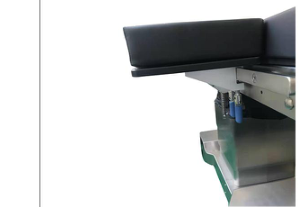
Universal operating table compatibility — All arch frames mount to standard operating table side rails from any manufacturer, eliminating the need for brand-specific adapters and enabling seamless integration across multi-brand hospital environments.
Abdominal decompression for reduced blood loss — By spanning the patient's torso and creating a gap beneath the abdomen, the arch frame allows the abdomen to hang freely — reducing intra-abdominal pressure, decreasing epidural venous engorgement, and minimizing intraoperative blood loss during posterior spinal decompression and instrumentation. This well-documented clinical benefit improves surgical visualization and reduces transfusion requirements.
Lordosis-matching adjustable geometry — The adjustable arch spacing allows the frame to conform to the patient's natural lordotic curvature — from the shallow cervical lordosis to the deep lumbar lordosis — ensuring that the spine is maintained in a neutral, anatomically correct alignment during the procedure without excessive flexion or extension that could compromise neurological function or distort the surgical anatomy.
Model Variants & Specifications
Stainless Steel Arch Frames
FP-016-A1 — Adjustable Arch Frame (600 × 460 × 190–260 mm, 0–150 mm Spacing, Standard Adult)
The standard arch frame for adult lumbar and cervical procedures, constructed from stainless steel with overall dimensions of 600 × 460 mm and an adjustable height range of 190–260 mm. The arch features 0–150 mm adjustable spacing on both sides, allowing the width of the abdominal opening to be set precisely to match the patient's body dimensions — from slender adults requiring minimal opening to average-build patients requiring moderate opening for comfortable abdominal decompression.
The 600 mm length provides adequate coverage from the upper thorax to the pelvis for standard lumbar and cervical procedures, while the 460 mm width distributes the patient's weight across a broad support surface that prevents focal pressure on the thorax and iliac crests. The adjustable height range of 190–260 mm allows the arch to be set at the optimal elevation for the specific procedure — lower settings for cervical procedures where minimal elevation is needed, and higher settings for lumbar procedures where greater abdominal decompression is required.
The high-density rebound sponge cushion with anti-static PU leather cover provides firm, pressure-distributing support that resists compression set during procedures lasting many hours, and the anti-static properties protect intraoperative neurophysiological monitoring signals from electromagnetic interference. The frame disassembles completely for thorough cleaning between cases, and the stainless steel construction withstands repeated autoclave sterilization without degradation. This model is the workhorse of the arch frame range — the preferred choice for routine lumbar discectomy, lumbar laminectomy, cervical laminectomy, and standard posterior spinal fusion procedures in average-build adult patients.
FP-016-A2 — Adjustable Arch Frame (800 × 460 × 190 mm, 0–150 mm Spacing, Extended/Larger Patients)
An extended-length arch frame constructed from stainless steel with overall dimensions of 800 × 460 mm and a fixed height of 190 mm, featuring the same 0–150 mm adjustable spacing on both sides as the FP-016-A1. The 800 mm length — 200 mm longer than the standard model — provides extended coverage from the upper thorax to the lower pelvis, making it the preferred option for larger patients or extended lumbar work that spans multiple spinal levels from the thoracolumbar junction to the sacrum.
The extended length is particularly valuable in multi-level lumbar fusion procedures — such as L2–S1 posterior lumbar interbody fusion (PLIF) or transforaminal lumbar interbody fusion (TLIF) — where the surgical incision extends over a long segment of the spine and the arch frame must provide continuous support from the upper thorax to the pelvis without leaving unsupported gaps that could create focal pressure points. The extended length also accommodates larger patients whose torso dimensions exceed the 600 mm coverage of the standard model, ensuring that the chest and pelvis are fully supported on the cushion surfaces while the abdomen hangs freely in the central opening.
The 0–150 mm adjustable spacing allows the arch width to be set to match the patient's abdominal girth, and the 190 mm height provides adequate abdominal decompression for most lumbar procedures. The high-density rebound sponge cushion with anti-static PU leather cover and the disassemblable design for cleaning are identical to the FP-016-A1, ensuring consistent performance and infection-control compliance across the stainless steel arch frame family.
Carbon Fiber Arch Frame
FP-016-B — Carbon Fiber Adjustable Arch Frame (750 × 500 × 250–330 mm, 0–250 mm Spacing, Radiolucent)
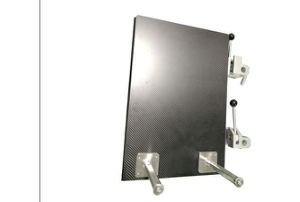
The most advanced arch frame in the range, constructed entirely from carbon fiber with overall dimensions of 750 × 500 mm and an adjustable height range of 250–330 mm, featuring an extended 0–250 mm adjustable spacing on both sides — significantly wider than the 0–150 mm range of the stainless steel models. This extended spacing range is specifically designed to accommodate bariatric patients and patients with significantly increased abdominal girth who require a wider abdominal opening to prevent compression during prone positioning.
The carbon fiber construction delivers two critical advantages over the stainless steel models: reduced weight for easier handling and repositioning between cases, and full radiolucency for C-arm guided procedures where intraoperative fluoroscopy is used to verify pedicle screw trajectory, interbody cage position, rod contour, and decompression adequacy in real time. The carbon fiber arch frame produces zero streak artifact, zero beam hardening, and zero scatter on intraoperative fluoroscopy — enabling the surgeon to obtain clear, diagnostic-quality images of the spinal anatomy and implant position without removing or repositioning the arch frame. This eliminates the need to pause the procedure, remove the frame, obtain the image, and then reposition the frame — saving significant operative time and reducing radiation exposure by minimizing the number of imaging passes required.
The 750 mm length provides extended coverage comparable to the FP-016-A2, while the 500 mm width offers broader lateral support for larger patients. The adjustable height range of 250–330 mm provides greater elevation than the stainless steel models, creating a deeper abdominal opening for enhanced decompression in patients with significant abdominal protuberance. The 0–250 mm adjustable spacing on both sides ensures that the arch can be configured to match any patient's body habitus — from slender adults to bariatric patients — while maintaining the precise abdominal decompression needed to minimize epidural venous engorgement and intraoperative blood loss.
The high-density rebound sponge cushion with anti-static PU leather cover provides the same pressure-distributing performance and IONM-compatible anti-static protection as the stainless steel models, and the frame disassembles completely for thorough cleaning between cases. This model is the preferred choice for C-arm guided pedicle screw instrumentation, minimally invasive spinal fusion, computer-navigated spine surgery, and any procedure where intraoperative fluoroscopy is an integral part of the surgical workflow.
Clinical Applications
This adjustable arch frame system supports procedures across the full spectrum of spinal surgery performed in the prone position:
Lumbar discectomy and microdiscectomy — The standard arch frame provides abdominal decompression and stable prone positioning for posterior lumbar disc herniation removal, with the adjustable spacing matching the patient's body habitus for optimal surgical access.
Lumbar laminectomy and laminotomy — The arch frame supports the patient's torso while leaving the posterior lumbar spine fully exposed for decompressive laminectomy of the spinal canal and neural foramina.
Posterior lumbar interbody fusion (PLIF/TLIF) — The arch frame maintains stable prone positioning during interbody cage insertion, pedicle screw placement, and rod fixation, with the carbon fiber model enabling real-time fluoroscopic verification of implant position without frame removal.
Multi-level lumbar fusion — The extended-length FP-016-A2 provides continuous support from the upper thorax to the pelvis for multi-level fusion procedures spanning L2–S1, preventing unsupported gaps that could create focal pressure points during lengthy instrumentation procedures.
Cervical laminectomy and posterior cervical fusion — The arch frame's adjustable height and spacing accommodate the narrower thoracic aperture and shallower lordotic curve of the cervical spine, providing stable prone positioning for posterior cervical decompression and lateral mass or pedicle screw instrumentation.
Thoracic spine surgery — The arch frame supports the patient's torso during thoracic laminectomy, thoracic disc herniation removal, and posterior thoracic fusion, with the adjustable spacing accommodating the relatively narrow thoracic cage.
Spinal deformity correction — The adjustable arch frame accommodates the altered spinal geometry and body habitus of patients with scoliosis, kyphosis, and sagittal imbalance, providing stable prone positioning for posterior spinal osteotomy, realignment, and long-segment instrumentation.
Revision spinal surgery — The adjustable spacing accommodates the altered body habitus and surgical anatomy of patients undergoing revision procedures where scar tissue, previous instrumentation, and spinal deformity create unique positioning challenges.
Minimally invasive spine surgery (MISS) — The carbon fiber FP-016-B provides full radiolucency for percutaneous pedicle screw placement, endoscopic decompression, and tubular retractor-based microdiscectomy where continuous fluoroscopic guidance is essential.
Computer-navigated spine surgery — The radiolucent carbon fiber arch frame does not interfere with the optical or electromagnetic tracking systems used in computer-navigated pedicle screw placement and spinal instrumentation.
Bariatric spinal surgery — The FP-016-B carbon fiber arch frame with 0–250 mm adjustable spacing accommodates patients with significantly increased abdominal girth, ensuring adequate abdominal decompression and reducing the risk of pressure-related complications in this high-risk population.
Spinal tumor resection — The arch frame provides stable prone positioning for posterior spinal tumor resection including en bloc spondylectomy, intralesional excision, and separation surgery, with the carbon fiber model enabling intraoperative imaging verification of resection margins.
Traumatic spinal injury — The arch frame provides stable prone positioning for posterior spinal fixation of burst fractures, fracture-dislocations, and spinal cord injury requiring posterior decompression and instrumentation, with the adjustable spacing accommodating the body habitus of trauma patients.
Intraoperative neurophysiological monitoring (IONM) — The anti-static PU leather cover on all models prevents electrostatic interference with SSEP and MEP monitoring signals, ensuring reliable neurophysiological data throughout the procedure.
SEO Search Terms & Tags
spinal surgery posture frame · surgical arch frame · stainless steel spinal frame · prone position arch · cervical spine surgical frame · adjustable arch frame spine · lumbar surgery arch frame · thoracic spine posture frame · prone position spinal support · abdominal decompression arch frame · spinal surgery prone frame · carbon fiber spinal arch · radiolucent arch frame · C-arm compatible spinal frame · 0-150 mm arch spacing · 0-250 mm arch spacing · bariatric spinal surgery frame · multi-level lumbar fusion arch · pedicle screw positioning frame · posterior spinal fusion arch · anti-static PU leather arch cushion · high-density rebound sponge arch · disassemblable spinal arch frame · universal operating table arch frame · lordosis matching arch frame · epidural venous decompression arch · intraoperative fluoroscopy spinal frame · computer-navigated spine surgery arch · IONM compatible arch frame · spinal deformity correction positioning · revision spinal surgery arch · minimally invasive spine surgery frame · spinal tumor resection positioning
Meta Description (for product listing pages)
← Back to all productsAdjustable stainless steel and carbon fiber arch frames for prone-position spinal surgery. 0–150 mm arch spacing (stainless steel) and 0–250 mm arch spacing (carbon fiber) to match patient lordosis and body habitus. High-density rebound sponge with anti-static PU leather for IONM compatibility. Disassemblable for thorough cleaning. Universal operating table compatibility. Ideal for cervical, thoracic, lumbar, and multi-level spinal procedures including laminectomy, fusion, deformity correction, and C-arm guided instrumentation.